SINAW
In the 1930, the Chinese Nationalist government in Nanjing under the leadership of Chiang Kai-shek engaged with strategic military co-operation with the Fascist Italian Government under Mussolini. In June 1934, the Nationalist government signed a contract with S.A. Consorzio Aeronatico Italiano per la China (Aerochina), an Italian, government joint venture between Caproni, Breda, Fiat and Savoia (SIAI). Aerochina was invited to set up a new factory to produce Italian aircraft.
The new factory was named “Sino-Italian National Aircraft Works”, SINAW. In china the factory was known as 中意飛機製造廠 (Zhòngyì fēijī zhìzào chǎng, Sino-Italian Aircraft Manufacturing Plant). Construction started in 1935 at 三家店机场 (Sānjiādiàn jīchǎng, Sanjiadian Airport), today known as 南昌青云谱机场 (Nánchāng qīngyún pǔ jīchǎng, Nanchang Qingyunpu Airport). The Italians appointed Luigi Acampora as head of the factory. The Chinese appointed 宋子良 (Sòng Zǐliáng) as chairmen. The factory was to be fully operational by July 1937 per the contract, with all Italian personnel having withdrawn in 5 years.
The factory was completed ahead of schedule, and production began in November 1936 with an order for six Savoia S.81B bombers. Orders for the assembly of 30 Breda Ba.65 and 50 G.50’s were also made. However, aside from some trainer-aircraft parts, only two bombers were delivered and a third prepared for trials before the Japanese bombed the facility on October 20, 1937. The level of destruction varies between sources, between complete destruction and slight damage. It can be certain that (some) machinery and raw materials have survived. The 3th S.81 was destroyed as well.
After this air raid relations between Italy and China broke down. The cause of this differs between the two sides. The Italians cited an alleged lack of co-operation from the Commission of Aeronautical Affairs. The Chinese claim however that they found Italian personnel among the shot-down Japanese aircraft, who where directing the bombing raid from the sky. What both sides agree on is the timeline; the Italian government suspended all deliveries in November and recalled all technical personnel on December 9. The outstanding orders were cancelled. On the same day, Chiang Kai-shek confiscated all Italian shares and the factory was renamed 中央南昌飛機製造廠 (Zhōngyāng nánchāng fēijī zhìzào chǎng, Central Nanchang Aircraft Manufacturing Plant), under control of the Aviation Commission, together with the remain 300 Chinese workers.
2nd AFAMF
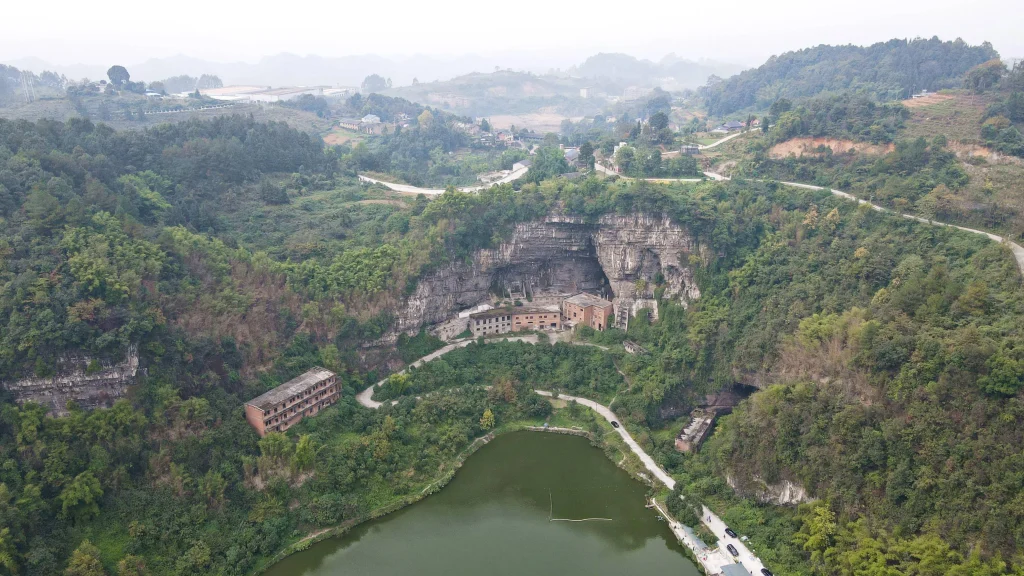
Late 1938, the factory ordered to relocate westward. About 1,000 employees and their families were relocated with the factory. All machinery that could be saved, stockpiled spare parts, weapons and raw materials were loaded onto wooden boats and shipped to Chongqing where they arrived early 1939. Several locations were considered, but finally the new factory, then known as the 第二飛機製造廠 (Dì èr fēijī zhìzào chǎng, Second Aircraft Manufacturing Plant (2nd AFAMF)), was setup in 海孔洞 (Hǎikǒngdòng, Haikong Cave), a cavern left behind by an ancient inland sea. The site was chosen due to it’s concealed nature, spacious interior and protection against bombing raids. The temple that was located at the entrance was destroyed.
At first, the cave was connected by a 5km road to the Sichuan-hunan Highay, and basic amenities were installed. The workshops were setup in the cave.
After the factory started operations, the Japanese sporadically flew reconnaissance missions in an attempt to find the factory. They were however unable to locate the cave. In response, they did bomb the town of Nanchuan, burning it to the ground.
Aircraft produced
- As SINEW
- 1937: 3 Savoia-Marchetti SM.81B bombers. 2 pressed into service, one destroyed during a Japanese air raid on the factory
- As 2nd AFAMF
- 1939 Chung 28A
- 1939 Chung 29A
- Hütter Hü 17
- 1943: 2 Zhongyun transport aircraft
Sources
- Liu, Qiangsi & Mansor, Suffian & Mat Enh, Azlizan. (2025). The Bombing of Sino-Italian National Aircraft Works (SINAW) in Nanchang -The End of Relations between Italy and the Kuomintang (KMT). e-Bangi Journal of Social Science and Humanities. 22. 10.17576/ebangi.2025.2203.33.
- https://web.archive.org/web/20190908130428/http://www.hongdu.com.cn/xwxx/233.html
- https://www.sohu.com/a/605063093_401870
- https://www.reddit.com/r/urbanexploration/comments/14av0g5/a_former_aircraft_factory_in_the_cave_during_ww/
- https://mzj.cq.gov.cn/sy_218/bmdt/mzyw/202412/t20241226_14022185.html